
See the batteries running in five countries, and everything waiting to join them.
Britain in full: what each battery is paid, who owns it, who trades it, and which of the 436 GW in the queue is likely to fail. Ireland, Germany and Italy from their published registers. Finland from Fingrid’s own count and the markets it runs, twice a week.
- Great Britain8.0 GW runs today436 GW asking to connect
- Ireland and Northern Ireland1,049 MW in the market3.8 GW contracted, not yet energised
- Germany4.3 GW registered as operating9.3 GW registered as planned
- Italy0.8 GW named and running290 GW asking to connect
- Finland2.1 GW Fingrid’s count1.6 GW named, being built
Across Europe: the day-ahead price, country by country, read for batteries →
Filled, a market the site publishes. Outlined, a market being read and checked, with nothing published from it yet.
How to read the map
Great Britain: the haze is the 247 GW of the queue at points with a known position; the other 189 GW sits at points with no published location. Three operating sites with no published position, 315 MW, are not drawn.
Ireland and Northern Ireland: the points are the 1,049 MW of batteries in the all-island market, as SEMO registers them; the haze is the 3,838 MW contracted and not yet energised, at its station. 9 of 73 batteries could not be placed by name.
Germany: the points are the 4,337 MW of batteries of a megawatt or more registered as operating, at their registered coordinates. The haze is the 9,326 MW registered as planned that the Germany page counts; the 3,304 MW it holds apart as doubtful is left off. Germany’s connection queue is not public. Pumped storage is not drawn.
Italy: the haze is Terna’s 290 GW, at the centre of each municipality, the closest Terna publishes; the points are all the 17 running batteries the public record names, at their municipality.
Finland: no Finnish body publishes a list of its batteries. The card gives Fingrid’s own count, 2,057 MW on 18 October 2026; the points are the 457 MW of it their owners name as running, at the place GeoNames gives their name or municipality, and the haze is the 1,600 MW their owners say is being built. 6 of 89 named batteries could not be placed. Fingrid publishes no queue; it says more than 30 GW of storage has asked to connect (26 September 2025).
One real day
On Saturday 10 October the grid paid batteries to charge at lunchtime, then wanted power back at £210 by half past six.
The imbalance price each half hour, on the day with the widest swing of the seven to 16 October. Watch a four hour battery fill up while the price is below zero and empty in the evening.
Five markets, read the same way
The same method in each country: the register, the operating fleet and, where a country publishes it, what the fleet is paid, all from published files, rebuilt on every refresh.
Great Britain
Registers read twice a week since August 2026Italy
Read monthly from Terna since 12 October 2026Ireland and Northern Ireland
Registers read monthly, meters daily, since October 2026Germany
The federal register, read daily since October 2026Finland
Fingrid read twice a week since October 2026Three products
The register is free because it traces to published files. The work we add sits behind a key.
The Fleet
Every operating battery: what it earns, who owns it, who trades it, and what it is doing right now, measured from settlement rather than modelled.
The Development Atlas
The connection queue on a map: what is contracted, what is likely to fail, where capacity comes back, and what changed since the last read. Who is really behind each project is the part we resolve ourselves.
The Forecast
Tomorrow’s price, published each morning before the auction, and the long term view drawn from every public report so a page never shows nothing.
Latest findings
Short pieces written from the data, each one traceable to the files it was read from.
The company that sells a battery’s power usually does not own it
We followed the control filings behind every operating battery in Britain. On 118 of the 182 we can name, the company selling into the market is somebody else entirely. Coverage stands at 83 per cent of operating capacity.
Read it →
123 GW of the queue is contracted at connection nodes with no published location
122 strategic connection nodes created by the connections reform hold 123 GW of contracted storage between them. No published source places any of them, and they hold not one megawatt of Gate 2.
Read it →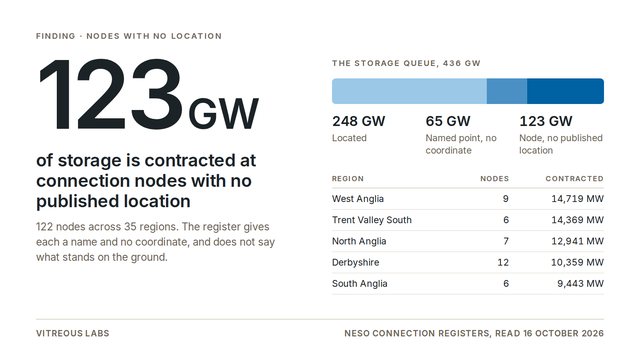
A battery in North Scotland is turned down 41 times as often as it is turned up
A full year of Elexon settlement data across the traded fleet shows a north to south gradient: the further north an asset sits, the more the system uses it as a sink and the less it earns. Two small English zones interrupt it.
Read it →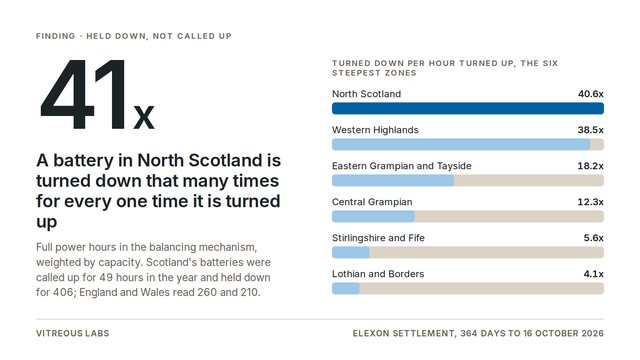


How it is kept honest
Every number traces to a published file or is labelled as inference. The three marks below appear on every map and every page.
How every number is worked out · What you may do with each layer
The Friday ledger
Every Friday, every change in the queue since the last read: new requests, withdrawals, dates that moved, capacity that came back. One email, no commentary you did not ask for.
Confirm by email, unsubscribe from any issue. We store the address and nothing else.
The ledger covers Great Britain today. Each other market has its own What changed page on the site: Ireland, Germany, Italy, Finland.